
Roof Ventilation and Underlayment in Hudson, WI
Roof ventilation and underlayment in Hudson are the parts of a roof you never see: the vents that keep the attic cold and dry, and the layers under the shingles that stop water the shingles let past. Hudson Roofing Pros installs and fixes both on homes in Hudson and western Wisconsin, built for the snow, ice and freeze-thaw this area gets.
Available now · Open 24 hours
- Licensed
- Insured
- Since 2016
- Certified Technicians
- 10-Year Workmanship Warranty
- GAF Certified Contractor
What Roof Ventilation and Underlayment Do for a Hudson Home
Roof ventilation keeps a Hudson attic close to the outdoor temperature by letting air in low at the eaves and out high near the ridge, and underlayment is the layer under the shingles that sheds water if any gets past them.
A cold, dry attic matters most in winter. Warm, moist air from the house that reaches the attic condenses on the cold underside of the roof deck, and heat that reaches the deck melts snow that refreezes into ice dams at the eaves. Wisconsin's dwelling code puts it plainly: a house must be designed and built to prevent damage from condensation and ice damming. Venting carries that moisture out, while sealing and insulating the ceiling keeps the heat in the house where it belongs.
Underlayment is the second line of defense. Ordinary felt or synthetic underlayment covers the deck, a self-adhering ice-and-water membrane goes where ice dams and driven rain push water uphill, and a metal drip edge finishes the roof edges so water drops clear of the fascia.
How an attic should breathe
In at the eaves, out at the ridge
Air entering through the soffits and leaving high on the roof carries heat and moisture out of the attic.
Signs Your Hudson Attic Is Not Venting Properly
The surest signs a Hudson attic is not venting properly are frost or damp on the underside of the roof deck in winter and ice dams along the eaves, and both usually mean warm house air is getting in faster than it can get out.
Frost on the Roof Deck
White frost or drips on the nails and sheathing in winter show moist air is reaching a cold surface and staying there.
Ice Dams at the Eaves
Ice along the gutters means the upper roof is warm enough to melt snow, a sign of heat and air leaking into the attic.
Damp or Matted Insulation
Insulation that is wet or packed down has been soaking up condensation and has lost much of its value.
Soffit Vents Blocked
Insulation stuffed into the eaves can close off the low vents, so no fresh air enters the attic.
No High Vents
An attic with vents only at the soffits, or only on the gable ends, may not move air from low to high.
A Hot Attic in Summer
An attic that stays far hotter than outdoors on a summer afternoon is holding heat the vents should be letting out.
Seeing frost or ice dams on your Hudson roof?
We can check how your attic vents and where the warm air is coming from.
Ventilation and Underlayment Work We Do in Hudson
The ventilation and underlayment work we do in Hudson covers ridge vents, ice and water shield, drip edge, and attic insulation and air sealing, each of which can be done with a new roof or on its own.
Ridge Vents
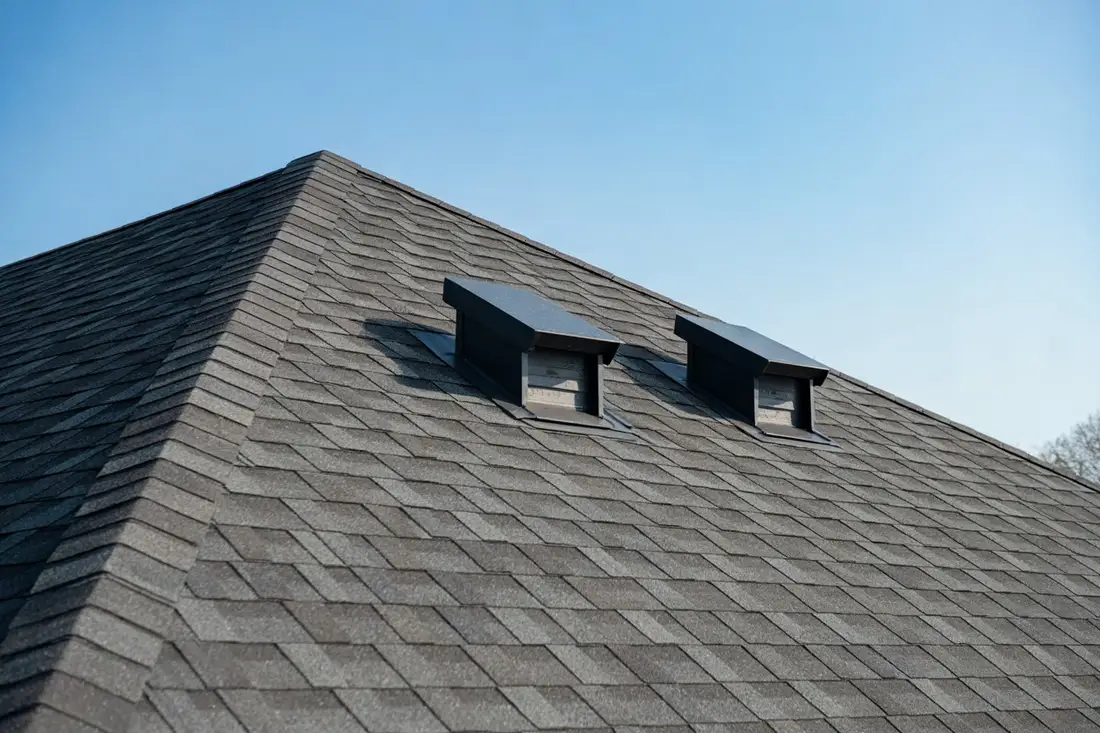
Ridge vent installation opens a continuous vent along the peak so attic air can leave at the highest point.
Ice and Water Shield
We lay ice and water shield at the eaves and in valleys so meltwater backed up by ice cannot reach the deck.
Drip Edge
Drip edge installation puts metal along the eaves and rakes so water drips into the gutter instead of behind it.
Attic Insulation and Air Sealing
Our attic insulation and air sealing work keeps house heat out of the attic, the lasting fix for ice dams.
Cody Larson, our roofing specialist, works on roofing, flashing and ventilation, and Garrett Olson personally oversees every project from the first inspection to the final cleanup.
How Much Attic Venting Does Wisconsin Require?
Wisconsin requires a vented attic to have at least half of its open vent area high on the roof and the rest low, with a total of at least 1 square foot of open vent area for every 300 square feet of ceiling, or 1 for every 150 if three-quarters or more of the venting is high.
The open vent area is the actual free space air can move through, not the size of the vent cover, so a long ridge vent and a row of soffit vents are measured by their openings. The code also says insulation must not block the free flow of air, which is why we keep the eaves clear when insulation goes in.
| Where the vents are | Minimum total open vent area |
|---|---|
| Half to three-quarters high on the roof, the rest low | 1 sq ft for every 300 sq ft of ceiling |
| Three-quarters or more high on the roof | 1 sq ft for every 150 sq ft of ceiling |
| Less than half high on the roof | Not allowed in a vented attic |
Small separate roof areas such as dormers, bump-outs and bays of 40 square feet or less do not need venting. An attic can also be built unvented when insulation that air cannot pass through is applied directly to the underside of the roof deck, under the conditions the code sets.
What Does Ventilation and Underlayment Work Cost in Hudson?
Ventilation and underlayment work in Hudson is priced by the piece, from roof vents at $240 to $600 down to drip edge at $1 to $2 a linear foot; these are national ranges, except insulation, which is a Twin Cities range, and none of them is a quote.
A ridge vent on a standard two-story gable house runs about $450 nationally. Most of this work costs least when it goes in with a new roof, because the shingles are already off. On a roof that is staying, we price the vents or insulation on their own.
Ventilation and underlayment pieces
National and Twin Cities ranges, not a quote.
What Wisconsin Requires Under Your Shingles
Wisconsin requires No. 15 asphalt felt or an equivalent underlayment under shingles, and on shingle or shake roofs over heated space with a slope of 4:12 or less, an ice barrier at the eaves.
That ice barrier, a self-adhering membrane or sheet metal, must run at least 30 inches up the slope from the roof edge and at least 12 inches past the inside face of the exterior wall, and it covers attached garages over heated space too. The code does not name drip edge, but it does require shingles to be installed to the manufacturer's instructions, so the shingle maker's instructions decide where drip edge goes. We follow them on every roof.
Ice barrier on low-slope shingle roofs
30 inches up, 12 past the wall
Both marks must be met on shingle roofs over heated space with a slope of 4:12 or less.
Who Can Do Roof Ventilation and Underlayment Work in Hudson?
Hudson Roofing Pros does roof ventilation, underlayment and attic insulation work in Hudson, and because Wisconsin has no roofing-specific license, the credential to ask about is the state's Dwelling Contractor certification.
Wisconsin's definition of a dwelling contractor names roofing and insulating, and any contractor who pulls a building permit for work on a one- or two-family home must hold the Dwelling Contractor certification and must hold or employ a certified Dwelling Contractor Qualifier. In the City of Hudson, roofing work with no structural changes does not need a permit; elsewhere we confirm the permit rules with your local building inspector before work starts. Ask us for proof of our credential and insurance when you book, and check any contractor on the state's credential lookup.
Roof Ventilation and Underlayment FAQs
Does My Roof Need Ventilation in Winter?
Yes, winter is when attic ventilation matters most in Hudson, because it carries out the moisture that would otherwise frost onto the cold roof deck.
Will a Powered Attic Fan Stop Ice Dams?
No, powered attic fans are not a recommended fix for ice dams in the Twin Cities climate Hudson shares. Sealing the ceiling and adding attic insulation stops the heat that makes the ice.
Is Ice and Water Shield Required in Wisconsin?
Yes, on shingle or shake roofs over heated space with a slope of 4:12 or less, an ice barrier is required at the eaves. Steeper roofs are not covered by that rule, though shingle makers and local inspectors can call for it there too.
Is Drip Edge Required in Wisconsin?
Wisconsin's dwelling code does not name drip edge; any requirement comes from the shingle maker's installation instructions, which the code says must be followed, or from a local rule.
Can I Get a Rebate for Attic Insulation in Hudson?
Possibly; Focus on Energy pays 2026 rebates for attic insulation and air sealing in homes served by participating utilities, but only when a participating Trade Ally does the work, so check that before you book.
Get a roof ventilation estimate
Send the form or call us and tell us what you are seeing, whether it is frost in the attic, ice dams or a roof that is due for replacement. We will look at the attic and roof and price the work.
Call now (651) 691-2168 Open 24 hours, 7 days a week