
Ice and Water Shield in Hudson, WI
Ice and water shield is a self-adhering membrane laid on the roof deck at the eaves and in valleys of Hudson homes, so water backed up by ice dams cannot get under the shingles and into the house. Hudson Roofing Pros installs it under new roofs across Hudson and western Wisconsin, to Wisconsin's rule and the shingle maker's instructions.
Available now · Open 24 hours
- Licensed
- Insured
- Since 2016
- Certified Technicians
- 10-Year Workmanship Warranty
- GAF Certified Contractor
What Ice and Water Shield Does on a Hudson Roof
Ice and water shield on a Hudson roof sticks directly to the roof deck along the eaves and in the valleys, forming a watertight layer that stops water pushed uphill under the shingles from reaching the wood.
Shingles are made to shed water running down the roof. An ice dam at the eaves does the opposite: it holds a pool of meltwater on the roof, and that water backs up under the shingle laps where nothing is meant to stop it. Ordinary underlayment slows it down, but the self-adhering membrane is what keeps it out of the deck, the wall and the ceiling below.
It is the backup layer, not the cure. Ice and water shield does not stop ice dams from forming; keeping house heat out of the attic does that. It is one part of our roof ventilation and underlayment work, along with the venting and insulation that keep the roof cold.
Ice barrier on low-slope shingle roofs
30 inches up, 12 past the wall
On shingle roofs over heated space with a slope of 4:12 or less, the barrier must reach both marks.
Where Ice and Water Shield Goes on a Hudson Roof
Ice and water shield goes on a Hudson roof wherever water is likely to back up or collect under the shingles, starting with the eaves and the valleys.
Along the Eaves
The lower edge over the overhang is where ice dams form, so the membrane runs up from the roof edge to past the inside of the wall.
In Closed Valleys
Where two roof slopes meet in a closed valley, the membrane can serve as the valley lining under the shingles.
On Low-Slope Roofs
Shingle roofs at 4:12 or less drain slowly, and Wisconsin requires the ice barrier at their eaves when they sit over heated space.
Over Attached Garages
An attached garage roof over heated space falls under the same eave rule as the house.
Getting water stains near your outside walls every winter?
We can check whether your roof has an ice barrier at the eaves.
How We Install Ice and Water Shield in Hudson
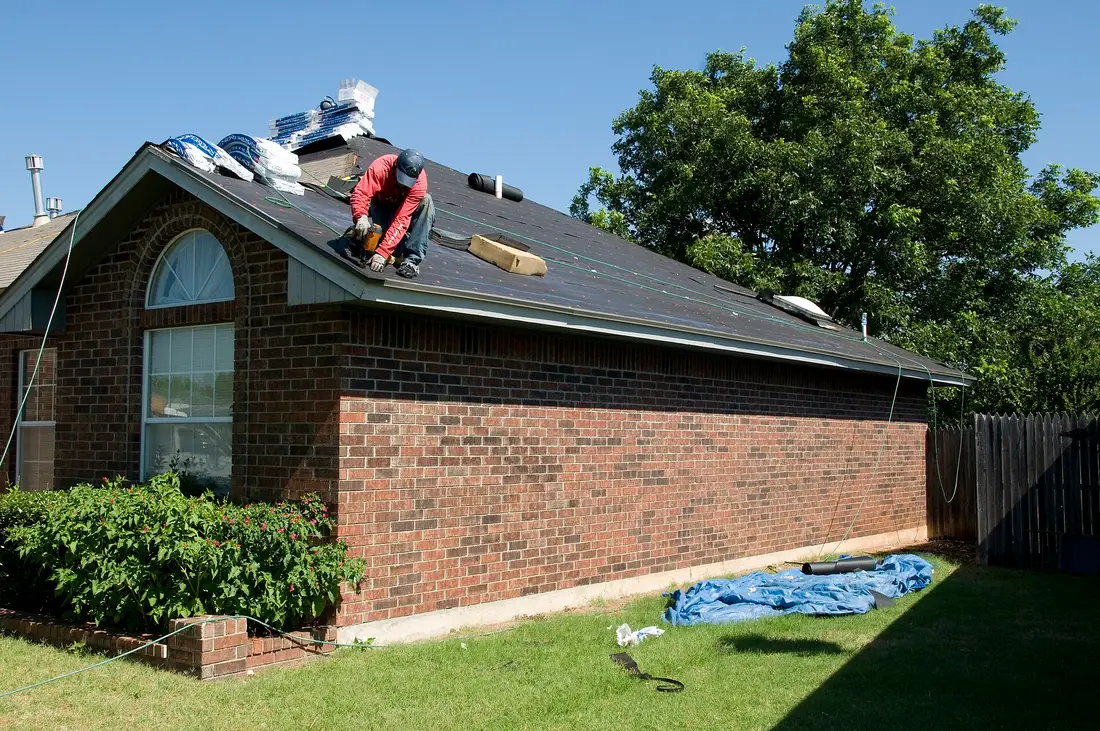
We install ice and water shield in Hudson on the bare roof deck during a roof replacement, after the old roofing is off and any damaged wood is replaced, and before the regular underlayment and shingles go on.
- 1
Strip to the Deck
The old roofing comes off so the membrane can stick to clean, dry wood.
- 2
Repair the Deck
Soft or rotted sheathing is replaced first, often found at the eaves where past ice dams have leaked.
- 3
Measure the Eave Coverage
We mark the line at least 30 inches up from the roof edge and at least 12 inches past the inside face of the exterior wall, and cover to whichever is higher.
- 4
Lay the Membrane and Edge Metal
The membrane and the drip edge go on at the eaves in the order the shingle maker's instructions call for, then the membrane goes into the valleys.
- 5
Underlay and Shingle the Rest
Regular underlayment covers the rest of the deck, and the shingles go on to the manufacturer's instructions.
Ice and Water Shield or Ordinary Underlayment for Your Hudson Roof?
A Hudson roof needs both: ordinary underlayment covers the whole deck under the shingles, and ice and water shield goes where water backs up, at the eaves and in valleys.
Wisconsin requires No. 15 asphalt felt or an equivalent under all shingles, and self-adhering membranes of the kind used at the eaves also meet that requirement. The difference is how each handles standing water.
Ordinary Underlayment
- Covers the whole roof deck
- Sheds water running down the roof
- Laid loose and fastened through
- Required under all shingles in Wisconsin
Ice and Water Shield
- Goes at the eaves and in valleys
- Sticks to the deck to hold back water pushed uphill
- Keeps ice dam meltwater out of the deck and walls
- Required at the eaves of low-slope shingle roofs over heated space
Planning a new roof and want the eaves protected?
Ask us to show you where the ice barrier will go on your roof.
What Does Ice and Water Shield Cost in Hudson?
Ice and water shield material costs $0.75 to $0.90 a square foot across the US, and adding it to a shingle roof job runs about $1,000; these are national figures, not a quote, because no Hudson or Twin Cities figure is published.
How much membrane a Hudson roof needs depends on the length of the eaves, the depth of the overhang, the number of valleys and the slope. We measure your roof and price it as part of the new roof.
Ice and water shield, national range
National range, not a quote.
What Wisconsin Requires for Ice and Water Shield
Wisconsin requires ice dam protection on shingle or shake roofs that extend over a heated part of a home or attached garage and have a slope of 4:12 or less, using a self-adhering membrane or sheet metal at the eaves.
The barrier must run at least 30 inches up the slope from the roof edge and at least 12 inches past the inside face of the exterior wall, so a home with a deep overhang needs more than 30 inches to reach the second mark. Roofs steeper than 4:12 are not covered by that rule as it reads today, but shingle makers and local inspectors can call for the barrier there as well. A cold attic is still the main defense, so we pair the barrier with good ridge vent installation and soffit venting.
A deep overhang needs more
Past the inside of the wall
The barrier has to reach 12 inches beyond the inside face of the exterior wall, not just 30 inches up.
Who Can Install Ice and Water Shield in Hudson?
A contractor holding Wisconsin's Dwelling Contractor certification, with a certified Dwelling Contractor Qualifier, can install Ice and Water Shield in Hudson, because that is the credential the state requires of anyone who pulls a building permit for work on a one- or two-family home, and Wisconsin has no roofing-specific license. Hudson Roofing Pros does this work, and when you book with us or anyone else, ask for proof of the credential and of insurance.
Any contractor who pulls a building permit for work on a one- or two-family home in Wisconsin must hold that certification and must hold or employ a certified Dwelling Contractor Qualifier. In the City of Hudson, replacing roofing with no structural changes does not need a permit; elsewhere we confirm the permit rules with your local building inspector before work starts. Ask us for proof of our credential and insurance when you book, and check any contractor on the state's credential lookup.
Ice and Water Shield FAQs
Is Ice and Water Shield Required in Wisconsin?
Yes, on shingle or shake roofs over heated space with a slope of 4:12 or less, Wisconsin requires an ice barrier at the eaves reaching at least 30 inches up and 12 inches past the inside of the exterior wall.
Does Ice and Water Shield Stop Ice Dams?
No, ice and water shield keeps meltwater out of the deck when an ice dam forms, but only air sealing and insulation stop the dams forming. Our attic insulation and air sealing work deals with that.
Can Ice and Water Shield Be Added Without a New Roof?
Not easily; the membrane has to stick to the bare roof deck, so the shingles over the eaves would have to come off, which is why it normally goes in with a roof replacement.
Does Ice and Water Shield Replace Drip Edge?
No, they do different jobs; the membrane seals the deck under the shingles, and drip edge is metal at the roof edge that sends water into the gutter.
Get an ice and water shield estimate
Send the form or call us and tell us about your roof and any winter leaks near the eaves. We will look at it and price a new roof with the ice barrier in place.
Call now (651) 691-2168 Open 24 hours, 7 days a week